On the rock
What to see on the Acropolis
What to see on the Acropolis of Athens in walking order: the Beulé Gate, Propylaea, Temple of Athena Nike, Parthenon, Erechtheion and the south slope.
See tour dates ↗Quick answer
On the Acropolis you walk through the Beulé Gate and the Propylaea, pass the small temple of Athena Nike, reach the Parthenon, then the Erechtheion with its Caryatid porch. On the south slope below are the Theatre of Dionysus and the Odeon of Herodes Atticus. A guided tour may reverse this order and start on the south slope.
The Beulé Gate
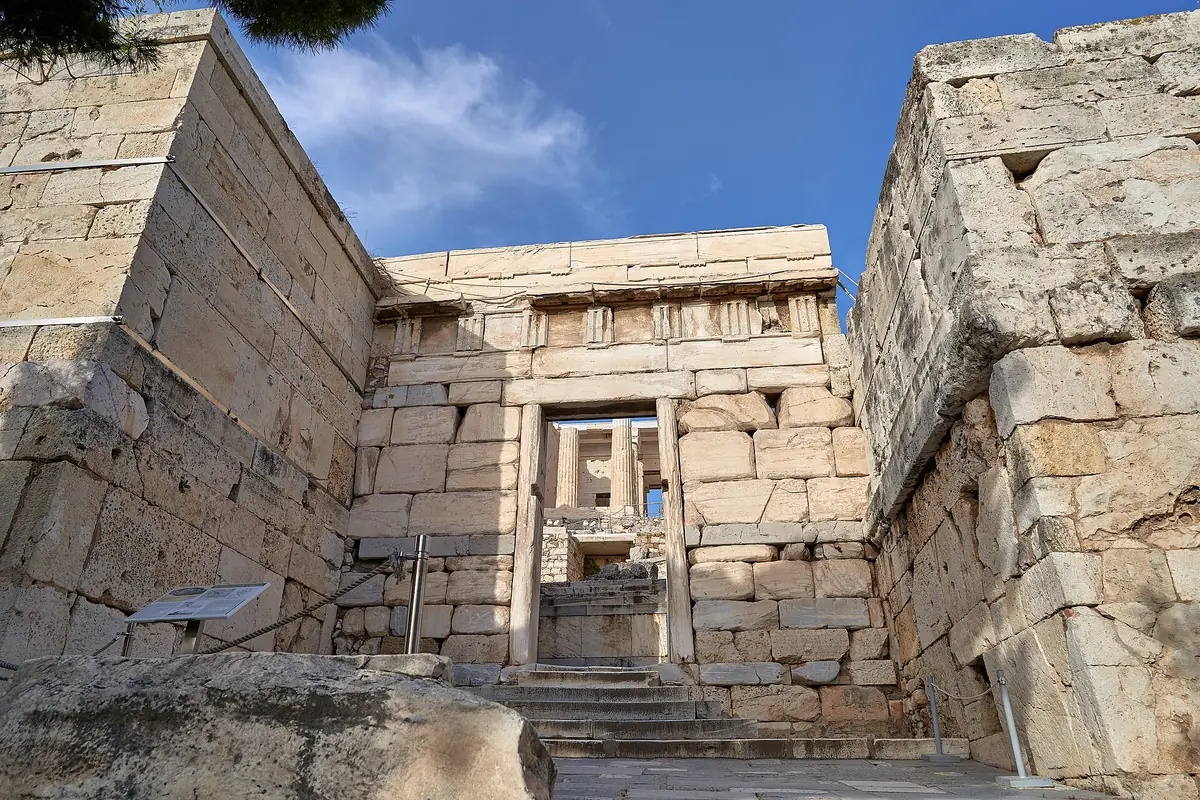
The first building you meet is not Classical. The Beulé Gate is a late Roman gateway, generally dated to the late third or early fourth century CE and probably built after the Herulian sack of Athens in 267. It is made almost entirely of marble reused from an earlier monument, and it stands at the foot of the staircase that leads up to the Propylaea. The French archaeologist Charles Ernest Beulé discovered it in 1852. It is easy to rush past, but it shows that the rock was a fortress as well as a sanctuary.
The Propylaea
The Propylaea is the monumental gateway to the summit, begun around 437 BCE under the Athenian architect Mnesicles as part of Pericles' rebuilding of the rock. Work was suspended because of the Peloponnesian War, so the building was never finished as planned. You walk through it today, as pilgrims did, and the worn marble underfoot is part of the experience. Beyond it the rock opens out, and the Parthenon appears on your right. Pause here, because the Propylaea frames the summit better than anywhere else on the climb.
The Temple of Athena Nike
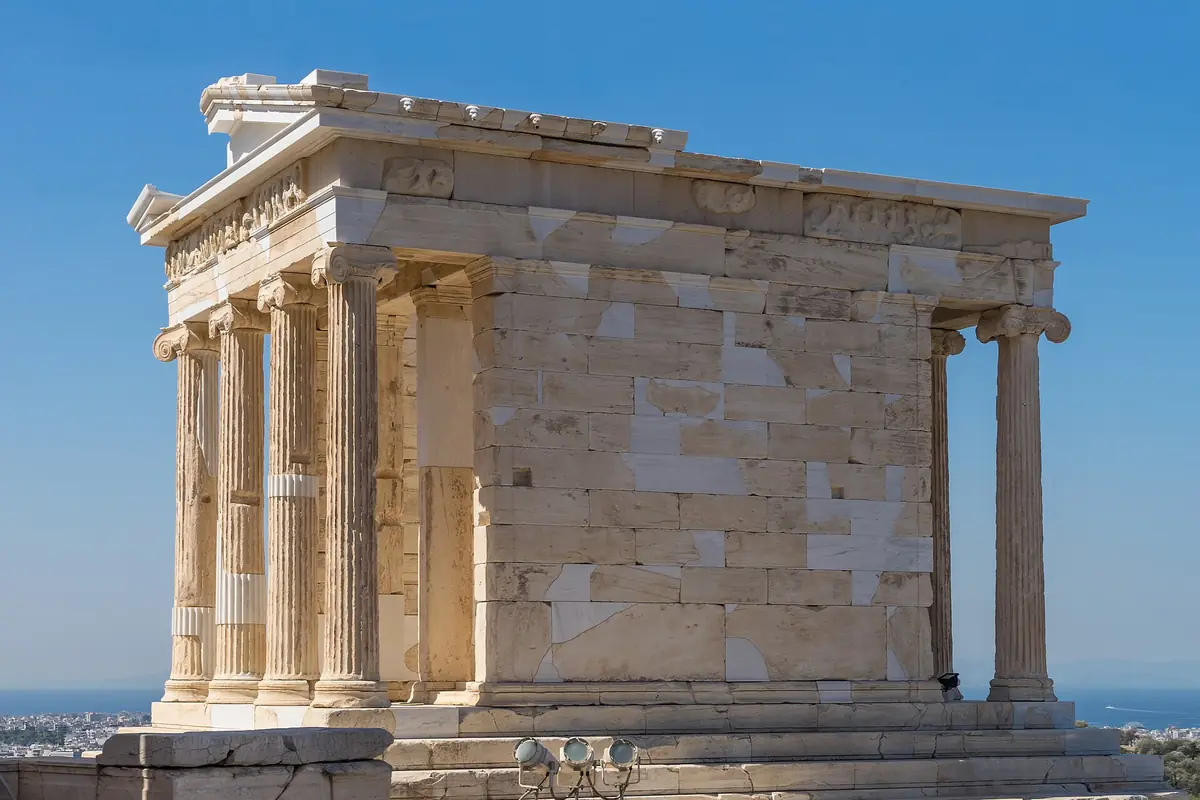
On a bastion at the south-west corner, to the right of the Propylaea, stands the small temple of Athena Nike. Designed by the architect Callicrates and finished around 420 BCE, it is the earliest fully Ionic temple on the Acropolis, only about 8 metres long. Nike is the goddess of victory, and Athena was worshipped here in that form. The Ottomans demolished the temple in the late seventeenth century and used its stones for defences. It was rebuilt in the 1830s and restored again in recent decades, so it is a small building with a long history of repair.
The Parthenon
The Parthenon was built between 447 and 432 BCE, with the architects Iktinos and Callicrates and the sculptor Phidias supervising the work. It is a Doric temple with eight columns across the front and seventeen on each side, dedicated to Athena. Inside once stood a huge gold and ivory statue of the goddess by Phidias, which is lost. The building became a church, then a mosque, and in 1687 a Venetian shell hit the Ottoman gunpowder store inside it, blowing out the middle of the building. Restoration has continued since 1975, so scaffolding is part of the scene.
The Erechtheion and the Caryatids
The Erechtheion stands on the north side of the summit. It is an Ionic temple traditionally dated to 421 to 406 BCE, and it housed shrines of Athena and Poseidon-Erechtheus. Its southern porch is held up by six female figures, the Caryatids. Five of the originals are now in the Acropolis Museum and replicas stand here, while the sixth was removed by Lord Elgin and is in the British Museum. Look for the porch's coffered ceiling, where marks were long said to be left by a thunderbolt of Poseidon. Stand back to see all six.
The south slope
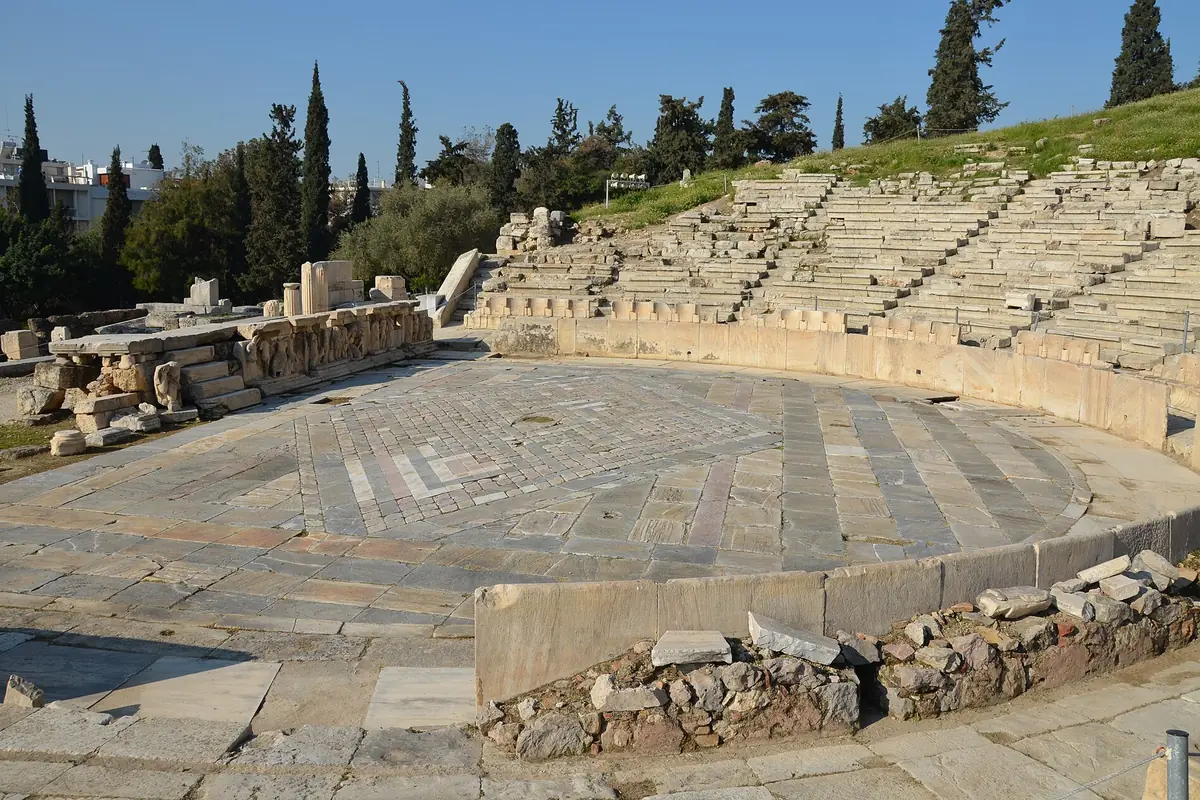
Below the rock on the south side lies a string of monuments. The Theatre of Dionysus is considered the oldest theatre, with its first orchestra terrace dating to the mid to late sixth century BCE, and it staged plays by Aeschylus, Sophocles, Euripides and Aristophanes. Its front-row stone seats were seats of honour. To the west lie the Asklepieion, founded around 419 to 418 BCE for the healing god Asclepius, and the Roman Odeon of Herodes Atticus, built in 161 CE and still the main venue of the Athens Festival from May to October.
Who this isn't for
If you expect to step inside every building, the Acropolis can disappoint. You walk around the temples on the marked paths, so what you see is exterior, scale and setting. It also is not a good fit if you want a quick look and a hurried exit, because the best moments are the slow ones. If time is tight, skip the Asklepieion and the south slope and see the Propylaea, the Parthenon and the Erechtheion, which take the least time and give the most. A guide helps by turning stones into stories.
Frequently asked questions
What is the best order to see the Acropolis?
The Beulé Gate and Propylaea, Athena Nike, the Parthenon, the Erechtheion, then the south slope.
Do you walk inside the Parthenon?
You walk around the Parthenon and the other temples on the marked paths, and the guide explains what each building was for.
Where are the original Caryatids?
Five are in the Acropolis Museum. Replicas stand on the Erechtheion, and the sixth original is in the British Museum.
What is on the south slope?
The Theatre of Dionysus, the Asklepieion and the Odeon of Herodes Atticus.
Why is there scaffolding on the Parthenon?
The Acropolis Restoration Project began in 1975, and work continues.
Sources